
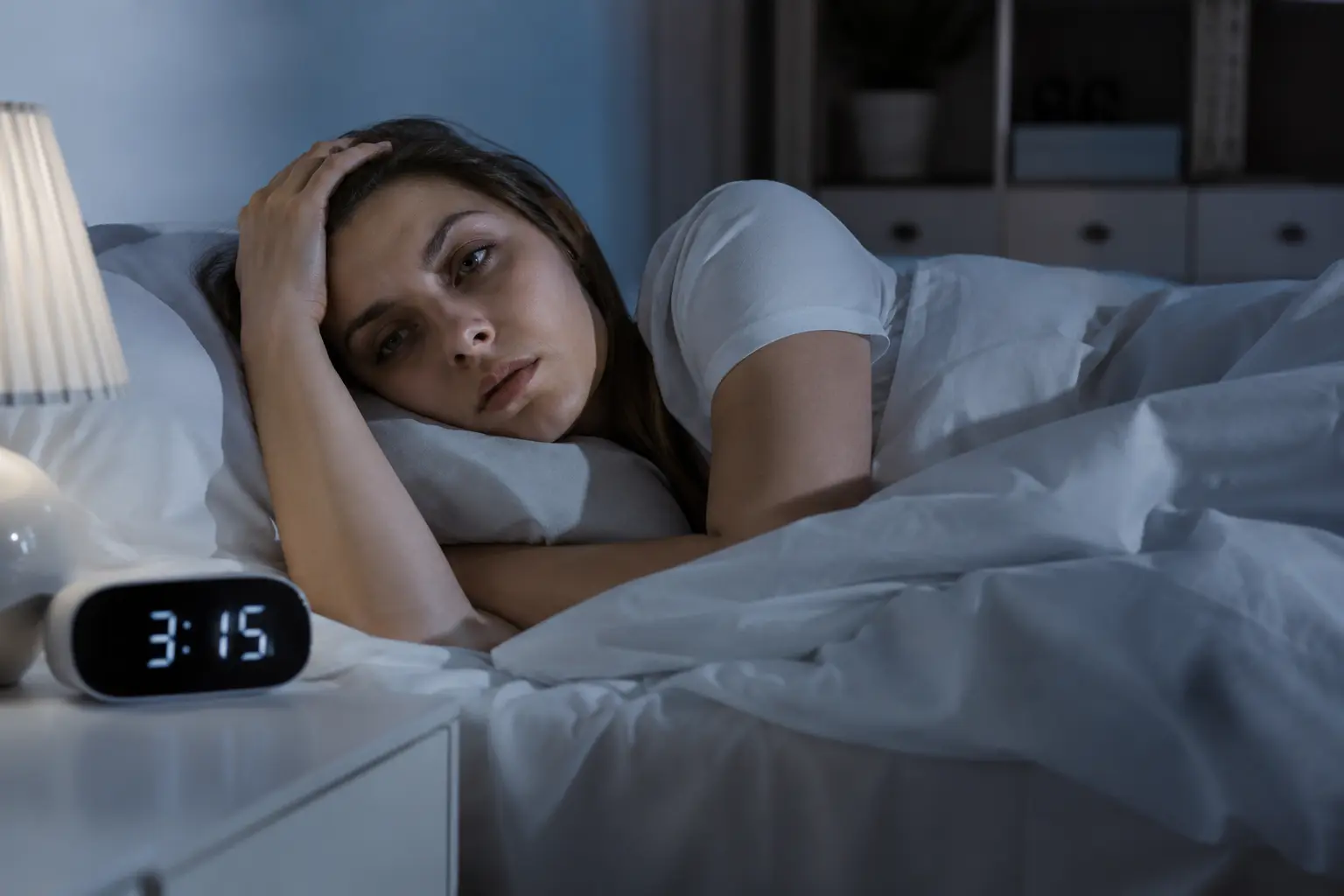
When life gets busy, sleep is usually the first thing to go. It feels like the safest place to cut. You cannot skip a deadline. You cannot skip picking up your kids. But shaving an hour off the night, or pulling one later, seems relatively harmless.
The research on this is fairly blunt. That trade-off is backwards. Sleep is not the flexible part of the system. It is closer to the foundation the rest of the system stands on, and when it goes, the parts of your mental health you were trying to protect by staying up tend to be the first ones that suffer.
It Runs Both Directions
Most people think about this relationship in one direction: stress and anxiety make it hard to sleep. That part is true. But the research shows that it also runs the other way, and just as strongly. Poor sleep does not just follow anxiety and depression. It actively produces and worsens them.
This bidirectional quality matters because it changes how you think about fixing either problem. If you assume sleep trouble is purely downstream of stress, the instinct is to wait for the stress to resolve and expect sleep to follow. Often it does not work that way. Sometimes the sleep problem has become its own independent driver, feeding the anxiety or low mood rather than simply reflecting it, which means it needs to be addressed directly rather than waited out.
The Numbers Are Larger Than Most People Expect
Research has found that people with insomnia are roughly 10 times more likely to develop clinically significant depression and 17 times more likely to develop clinically significant anxiety compared to people without sleep problems. Those are not small odds ratios. They describe insomnia as one of the strongest predictors of future mental health problems that researchers have identified, on par with or exceeding several risk factors that get far more public attention.
A 2025 study in PLOS ONE found that nearly 60% of people sleeping five hours or less per night met the criteria for depression, compared to 42.8% of people getting the recommended amount of sleep. That is not a small gap. It is close to a 20-point difference in depression rates tied to something as specific and measurable as hours of sleep.
Here is the part that actually matters most for what to do about it. A meta-analysis of 65 randomized controlled trials concluded that the relationship between sleep and mental health is causal, meaning interventions that successfully improved participants’ sleep directly produced improvements in their overall mental health. This is a meaningfully different claim than correlation. It means fixing sleep is not just associated with better mood and less anxiety. In controlled studies, it actually produced those improvements.
What Is Actually Happening in the Brain
The mechanism behind all of this is not mysterious, and understanding it helps explain why sleep loss feels so specifically destabilizing rather than just generally unpleasant.
Sleep, particularly REM sleep, plays a central role in emotional processing, while non-REM sleep supports physical recovery. When these stages are disrupted, the prefrontal cortex’s ability to regulate the amygdala is impaired, which leads to heightened emotional reactivity.
In plainer terms, your prefrontal cortex is the part of your brain responsible for perspective, judgment, and keeping your emotional responses proportionate to what is actually happening. Your amygdala is the part responsible for the raw emotional alarm, fear, threat detection, and reactivity. On a well-rested night’s sleep, the prefrontal cortex keeps a fairly firm hand on the amygdala, tempering its responses and keeping things in proportion.
Sleep deprivation weakens that connection. The amygdala becomes more reactive, and the prefrontal cortex becomes less able to rein it in. This is why a bad night of sleep can make a minor inconvenience feel like a genuine crisis, why irritability spikes, and why anxious thoughts that would normally pass through your mind and dissolve instead seem to stick and intensify. You are not imagining that everything feels more intense after a bad night. Your actual neurological capacity to regulate that intensity has been temporarily reduced.
Who Tends to Sacrifice Sleep First
Certain people are more likely to treat sleep as the expendable line item in a busy life, and the pattern is worth naming.
People managing burnout often cut sleep specifically to try to keep up with a workload that has already exceeded what is sustainable, which creates a genuinely difficult loop. The exhaustion from burnout makes rest more necessary, while the same pressures that caused the burnout make rest feel like the one thing that can be sacrificed to buy more hours.
People with high-functioning anxiety frequently describe a mind that will not quiet down at night, reviewing the day, anticipating tomorrow, running through scenarios that have not happened. For this group, the problem is often not a lack of opportunity to sleep. It is a nervous system that has not learned how to switch off the vigilance long enough to let sleep actually happen.
And for a smaller group of people, disrupted sleep is not the cause of a mood problem at all. It is one of the clearest signals of one. Significant, sudden changes in how much sleep someone needs, sleeping far less than usual while feeling energized rather than exhausted, or sleeping considerably more without feeling rested, can be a marker of a broader mood disorder rather than ordinary insomnia. This distinction matters clinically, because the treatment approach is different depending on which one is actually happening.
Why Sleep Hygiene Alone Often Is Not Enough
Most advice about sleep stops at the basics: consistent bedtime, no screens before bed, cooler room, less caffeine in the afternoon. These things genuinely help, and they are worth doing. But for people whose sleep problems have become chronic or are tied to an underlying anxiety or mood condition, hygiene changes alone tend to produce limited results.
Insomnia has a notably high persistence rate when left untreated, with research showing it remains present in about 71% of cases after one year, roughly half after three years, and more than a third after five years. In other words, chronic insomnia does not reliably resolve on its own just because life eventually calms down. It has a tendency to become self-sustaining, independent of whatever originally caused it.
Cognitive Behavioral Therapy for Insomnia, usually shortened to CBT-I, is the most well-supported treatment for chronic sleep problems and is generally recommended before medication for most cases. It works directly on the thoughts and behaviors that keep insomnia going, things like anxiety about not sleeping, which itself becomes one of the biggest obstacles to actually sleeping. For people whose sleep problems are tangled up with an anxiety disorder, depression, or a mood disorder, addressing the underlying condition alongside the sleep problem tends to produce much more durable results than treating either one in isolation.
If your sleep has been a genuine problem for months rather than weeks, and general sleep hygiene changes have not moved the needle, that is a reasonable point to bring it to a psychiatric provider rather than continuing to manage it alone. The evaluation and treatment options available through Inner Balance and Wellness can help sort out whether what you are dealing with is primarily a sleep problem, an anxiety or mood condition expressing itself through sleep, or some combination of both, which matters for getting the right treatment rather than guessing at it.
The Part Worth Remembering
Sleep is not the soft, negotiable variable in a demanding life. It is one of the few things in this entire conversation that is both a major driver of poor mental health and, according to the controlled research, a genuinely effective lever for improving it. Very few things in mental health care can make that claim with this much evidence.
The trade-off that felt reasonable at 11 pm- one more hour of work instead of sleep- is rarely actually a good trade. Most of the time, it is borrowing against tomorrow’s mood, tomorrow’s patience, and tomorrow’s ability to think clearly, at an interest rate higher than it appears in the moment.